Showing posts with label non-fiction. Show all posts

Tuesday, October 9, 2012

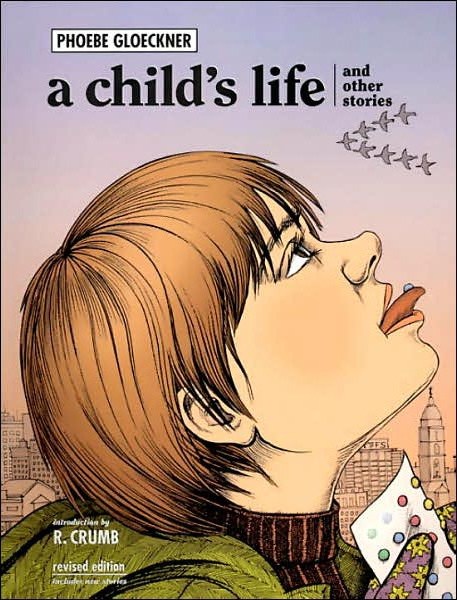
A Child's Life: Graphic Novel

A Child's Life
A Child's Life and Other Stories
Phoebe Gloeckner

This is one graphic novel that certainly lives up to its name. I'm glad I wasn't reading it in public when I turned the page and saw the panel depicting two young girls peeping in through a broken bathroom window and catching their stepfather in a *ahem* private moment. (Granted, there were far more disturbing scenes, but that was the first one that I recall being particularly explicit.)

I came across this title when I was looking for graphic novels written and illustrated by women. It seems like a lot of the well known books in this medium are by men, and if you've read my blog at all you probably know I like reading female authors. (And yes, I read male authors and yes I like them and yes Maus I & II are amazing).

The characters in A Child's Life and Other Stories are clearly based on Gloeckner's self and family and friends. It was a little odd to get used to at first, as she often changed the main character's name from story to story. It's understandable that she would want to put some distance between herself and some of these incredibly painful experiences. The stories are in rough chronological order, grouped as child years, to teen, to adult. They were not all completed at the same time, so there are very noticeable differences in drawing styles. This isn't a bad thing - in fact, the differences lend interesting visual variety.

This is not a book to willy-nilly recommend to your friends. It is intense. The subject matter is dark - excessive drug and alcohol abuse, pedophilia, rape, child abuse.

Unlike Maus, there is no attempt to depict the atrocities in anything other than minute detail. All the horrors are present for perusal, which can make you feel a bit like a creepy voyeur. What does this mean? What is the purpose of these artistic choices? Perhaps it's to force the readers' heads point at these acts, force them to watch and acknowledge they exist. Because unfortunately, there are too many children who know about them first hand.

Wednesday, September 26, 2012

The Devil in White City, at Long Last

The Devil in the White City
The Devil in the White City  
Erik Larsen

Apparently when Chicago hosted the World's Fair in 1893 it was a big freaking deal. Who knew? (Ok, I bet a lot of people knew, but clearly I was not one of them).

Larsen's book lays out exactly why the fair was such a major production, the immense efforts it required, the staggering obstacles that had to be overcome to have a dazzling spectacle succeed so well.

The parallel plot revolves around early American serial killer Dr. H.H. Holmes. Holmes took advantage of the large, transient crowds drawn to the fair to engage in a hobby a bit less wholesome than riding the Ferris wheel.

All in all, the book was engaging and well written. The only part that bothered me was there was lots of undiluted privilege being flung around. Of course, it's not like I wrote down any examples, like a good book  blogger would do. Also, I probably shouldn't have waited eighteen years to finish writing up my thoughts before posting them... Anyway! Read it! And read these other books while you're at it:

Want more like this? Try:
  • Theodore Dreiser, Sister Carrie. Those scenes when Carries first arrives in Chicago, when the city is still comprised largely of vacant lots, sprang to mind as I read about Chicago and the Fair being constructed.
  • Upton Sinclair, The Jungle. Chicago was known for its meatpacking, another bit of gruesome business.
  • Kevin Davis, Defending the Damned. Meet some modern Chicago killers, and those that defend them. 

Tuesday, September 11, 2012

Poetry After 9/11

Book cover, showing a view of lower Manhattan from the New York Harbor, showing the Twin Towers still standing.
Poetry After 9/11
Poetry After 9/11: An Anthology of New York Poets*
Edited by Dennis Loy Johnson and Valerie Merians

As with all poetry, this collection is not something to rush through. Especially with this collection, there is an intensity, even with the more lighthearted pieces.

Alicia Ostriker writes in the introduction, "Not many of the voices in this book are solemn. Now do they repeat. Like an explosion, the poems fly out in all directions from an ignited core.... This book is a portrait of the New York temperament, a tangle of cynicism, pride, humor, compassion, and of course confusion. Plus the capacity to absorb hurt and rebound."

One of the more lighthearted pieces was Paul Violoi's "House of Xerxes," which describes a scene that it a cross between the Olympic Parade of Nations and the best of Paris is Burning. Here's the first stanza:

Here come those splendid Persians!
We were expecting fireworks
And here they are!
Short bow, long arrows,
Colorful long-sleeve shirts
Under iron breastplates -
Nice fish-scale pattern on those breastplates.
Just the right beach touch, very decky.
Quivers dangling under wicker-worky sheilds,
A casual touch, that.
And those floppy felt caps
Make it very wearable, very sporty.
Huge amounts of gold,
A killer-look feel
But it still says A Day at the Shore.

There are, of course, poems that deal more directly with the attack, such as Ostriker's "The Window, at the Moment of Flame":

and all this while I have been playing with toys
a toy superhighway a toy automobile a house of blocks

and all this while far off in other lands
thousands and thousands, millions and million

you know - you see the pictures
women carrying bony infants

men sobbing over graves
building sculpted by explosion -

earth wasted bare and rotten
and all this while I have been shopping, I have

been let us say free
and do they hate me for it

do they hate me

***

My favorite line in the whole collection, and maybe one of my favorite lines, period, came from Charlie Smith's poem "Religious Art"

I press hard with my feet
against the earth and
call this fighting back

Every day.


*This book was sent to me by the publisher, Melville House

Monday, August 20, 2012

The Hanging of Angelique

The Hanging of Angelique
The Hanging of Angelique: The Untold Story of Canadian Slavery and the Burning of Old Montreal
Afua Cooper
"Slavery is Canada's best-kept secret, locked within the national closet. And because it is a secret it is written out of official history. But slavery was an institutionalized practice for over two hundred years. ...Canada may not have been a slave society - that is, a society whose economy was based on slaves - but it was a society with slaves."
Canadian slavery was certainly something I knew nothing about prior to reading this book. I was always taught that Canada was the promised land for slaves in the US, especially after the Fugitive Slave Act. Afua Cooper's groundbreaking book dispels that myth.

She focuses her narrative on one young enslaved woman, christened Marie-Joseph Angelique, who was accused of setting her mistress's house on fire and, as a result, burning down much of Old Montreal. Cooper is sure to put Angelique's story in context, explaining how slavery was an integral part of Canada's foundations.

Cooper does not shy away from placing blame on Angelique. In fact, the idea that this was a purposeful act, borne of the frustrations and chafing of the slave system, is central to her thesis.
"Did Angelique set the fire? Your guess is as good as mine. No one saw her light the spark that started the blaze. All the evidence was circumstantial. But I believe she did set it."
When Angelique set the blaze, she acted willfully, deliberately. She was not a woman to sit idly by and quietly bear the harsh hand she was dealt. Throughout her life she rebelled, through acts large and small. Her final act of rebellion ended up even bigger than she had probably anticipated.

Want more like this? Try:
  • Sojourner Truth, The Narrative of Sojourner Truth. Another slave narrative from a woman with Dutch ties.
  • Assata Shakur, Assata. A 1987 autobiography from another resistor that clearly shows the struggle continues.
  • Margaret Atwood, Alias Grace. The fictional retelling of a famous Canadian murder case. In this case, the accused is servant girl Grace Marks.

Thursday, July 26, 2012

Unbearable Lightness

Unbearable Lightness
Unbearable Lightness: A Story of Loss and Gain
Portia de Rossi

Here's the thing. I kinda liked this book. No, the writing isn't going to win any awards. Still, three stars. But while writing this review, I seemed to focus more on the negative. I don't want to give the wrong impression, so I'm putting this upfront :-)

You may recognize Portia de Rossi from Ally McBeal or Arrested Development or some other show, or from being married to Ellen Degeneres. I always thought she was incredibly beautiful and poised. In Unbearable Lightness, she lets the public into her very private, very scary struggle with an eating disorder and her dehabilitating self doubt. She is revealed as that girl that may come across cool and standoffish, but it's really because she's terrified that if people see her true self that her reputation and career will be destroyed.

As this is a book about a woman with an eating disorder, there are some very graphic passages. I felt physically ill at certain points, imagining the suffering that de Rossi was going through, denying her body the fuel it needed to exist.

It is so shocking to realize how far we've come in a relatively short time when it comes to LGBTQ acceptance. Of course, there is still a long way to go. De Rossi is very matter of fact about her career being stopped before it really would have started should anyone have found out she was gay. I am sure this still happens, probably pretty often, but it does seem like less of a big deal when a star comes out. Of course, there's a big difference between coming out on your own terms after building a successful career and being forcefully outed as a young Hollywood hopeful. Maybe that's changing?

The most powerful part of the book is when she juxtaposes her health diagnosis with pictures of herself when she was at her most sick. And truly, in most of them, she looks like any typical starlet. It's a shock to realize how many people must be starving themselves like she was.

I do wish there had been more focus on the "gain" part of the subtitle. De Rossi rather glosses over her struggle to recovery, and the stability and happiness she's found. It's clear there was a struggle, but it's only hinted at. She was so forthright in sharing her experience in the depths of her condition, I was surprised that she didn't detail how she got better. I feel it would have been a better aid to those that she says she wants to help. It was a bit simplistic - I found out I was sick, so I got better. I had an eating disorder because I was afraid of not being accepted as gay. I don't know - it just was a bit too pat.

Additionally, there were things in the "recovery" section that made me uncomfortable. She makes some rather judgmental pronouncements on eating habits in general, and she still seems to think that there is an acceptable weight range, or an acceptable way for weight to be distributed on one's body. There's a comment about people on treadmills vs. people who are "naturally" active, focusing on doing things like walking their dogs. While it seems that she's made progress, there are still some pretty damaging. For some thoughts bout what it's truly like to accept bodies, including fat bodies, I recommend checking out the Shapely Prose archives or Shakesville's Fatsronauts series. Also, for a great (and quick) summary about how not to talk about food and bodies around people with eating disorders, check out this post from a human story. It would be awesome to eliminate discussions about "good" and "bad" foods - you never know who's around to be hurt by these well accepted, seemingly harmless words.

Want more like this? Try:
  • Marya Hornbacher, Wasted: A Memoir of Anorexia and Bulimia. A non-celebrity take on the topic. Very interesting to see the similarities and the differences in how the eating disorders were manifested in the two women. 
  • Naomi Wolf, The Beauty Myth. I haven't read this one yet, but I do have a copy (thanks to the lovely Marilyn). De Rossi mentions this book frequently as opening her eyes to the impossible standards of beauty that women are expected to meet. Warning: Although this book is supposedly excellent, Naomi Wolf has been advancing more troublesome ideas in recent years.
  • Jessica Yee, Feminism, for REAL. To further the idea of accepting ourselves and those around us, regardless of appearance or anything else! This book is awesome, btw. Everyone should read it.

Friday, April 6, 2012

Making it Rain

How to Become a Rainmaker
Jeffrey J. Fox

I recently attended a CLE seminar on "Starting Your Own Practice" for lawyers. I wasn't exactly ready to go into business for myself right away, but the job market's been tough, and I figured learning a bit more about what it really takes to work for yourself couldn't hurt.

One of the panelists recommended a couple books on "rainmaking," or business development. He said there were a couple he found particularly helpful, but they all repeated many of the same ideas. He said this wasn't a bad thing, as sometimes the repetition can serve as a helpful reminder of things to do.

My cousin is very into business related issues, so I thought maybe he'd have one of the books. He didn't, but did let me borrow this one, How to Become a Rainmaker.

I read it on two separate days, probably less than a two hour total commitment. It's written in short, simple chapters, suitable for someone who is busy and looking for a quick tip they can read in the morning over their coffee.

The book is definitely geared towards salespeople, but there are tips that are good for people in all professions.

*First is one that I have a problem with, at least in my personal life: return all phone calls the day you get them. I know this is important. My new, "big" boss thinks it's of primary importance. So, I should probably work on this. I should be providing my clients the best service I can, and returning their calls promptly is a big part of that.

*Listen to want your client wants, ask enough questions to understand, and craft a responsive solution. Pretty self explanatory. This is just one that I'm actively working to get better at every day.

*When a client calls, you are never "in a meeting" or "unavailable." You are "with a client," or "in court." Now, I think the point is that you SHOULD be busy doing legitimate work, and if you're not, take your client's call. Otherwise, you're just going to have to call them back later that day :-)

Friday, February 10, 2012

Narrative Life of Frederick Douglass, & a Giveaway

Narrative Life of Frederick Douglass
Narrative of the Life of Frederick Douglass, an American Slave
Frederick Douglass

I confess, I've wanted to read this book for awhile, but I was under the impression it was going to be long and rather unwieldy. This was not the case at all. When I went to the bookstore to buy a copy (because can you believe my entire library system doesn't have it!) I was surprised to see that it was just over a hundred pages.

Douglass is not afraid to name names and detail the abuses suffered by himself and others he knew. The introduction points out that this lent to his credibility, as any false statements could be roundly attacked by his detractors. He details the horrors expected - separating family members, brutal whippings, cold-blooded murders. As bad as it was, though, there was always the terror of being sold even further south, where conditions were far worse.

Douglass also talks about how he learned to read, and that his master was right in saying that if slaves were educated and knew how to read they'd be more likely to rebel. He explains how, after his mistress was forbidden to teach him more, he covertly taught himself. I love the picture of his of learning from the area schoolchildren, using games and sticks in the dirt.

It's clear that Douglass was committed to helping other slaves achieve their freedom. He railed against the system like few others could, since he himself survived it. However, he criticized those who took a more literal approach in freeing those still in bondage - the operators of the Underground Railroad. He says that his concern is that they are telling slavery's operators how slaves are escaping, thereby increasing the chances that they'll be caught.

I have to admit I'm puzzled by this. I mean, yes, perhaps there was a general understanding that there's a network of people and safe houses that help transport people north. However, I don't exactly think the operators were publishing their routes. It's hard for me to agree that Harriet Tubman and others like her shouldn't have done what they did. Of course, perhaps there's more to this than I'm aware. I'm certainly not an expert in this area. I also respect the right of people to disagree about the best way to get to a shared end goal.

Anyway! Read this - seriously. It's good! And a classic! And there are two more autobiographies that follow it, so there's more to read.

One lucky commentor will WIN my copy. All you have to do is tell me something you're doing to celebrate Black History Month. I'll randomly choose a winner and email you for your address. Good Luck!

Want more like this? Try:*
  • Sarah H. Bradford, Scenes in the Life of Harriet Tubman. Tubman dictated incidents in her life to Sarah Bradford, an admirer. 
  • Mary Prince, The History of Mary Prince: A West Indian Slave Narrative. Prince's narrative was the first written by an enslaved woman. 
  • Briton Hammon, Narrative of the Uncommon Suffering and Surprising Deliverance of Briton Hammon. Generally considered the first slave narrative.

*These selections are taken from the back of my copy of Narrative, where other slave narratives are listed.

Friday, February 3, 2012

Ludwig van Beethoven

Beethoven: The Universal Composer
Edmund Morris

This is one of Harper Collins' Eminent Lives biographies, which are meant to be rather brief biographies of major historical figures written by distinguished contemporary authors. Certainly in the case of Beethoven we have an iconic subject. I confess, I'd never heard of Edmund Morris, though. It turns out he's written a few other books, including the 1980 Pulitzer Prize winning biography, The Rise of Theodore Roosevelt.

Apparently Morris is also a lifelong fan of music, especially Beethoven. This biography certainly makes that clear. He is able to bring Beethoven's music to life in the printed word. He describes the feeling that each piece of music produces, so even a person with a trifling knowledge of musical terms can follow along. There's also a glossary of musical terms in the back of the book to help you if you get lost. Of course, there's an element of skepticism when Morris describes, say, a piano cantata. Can I take his word as authority on the sound of this music? Just because he's a fan, does that mean I would be?  Ultimately, I let this be, because if anything it gave me an appreciation for Beethoven's work and made me seek out some pieces to listen to.

Morris was able to show what was going on in the world at large while Beethoven was living and writing. He was working during the French Revolution, and his Austrian patrons were justifiably concerned with their positions in society. At times they had less money or inclination to support a large cadre of demanding artists. Beethoven often had trouble collecting monies owed him.

Beethoven's personal life, including his money troubles, take up a good portion of the biography. It's interesting that during some of his most stressful personal periods he was able to concentrate and turn out some of his most brilliant masterpieces.

Unfortunately, when it comes to the more personal side of things, Morris misses the mark a bit. His privilege starts showing something awful. First, there's the anti-choice rhetoric. Morris retells some ridiculous story about someone asking a feminist what she'd tell a poor woman who'd lost previous children and was married to an abusive alcoholic what to do when she finds out she's pregnant. Abort? YOU JUST KILLED BEETHOVEN!!!!eleventy!!!11!

Don't worry, though - he's not concerned with Beethoven as a person, but only as a music maker. Later in the book, Beethoven is experiencing a particularly tough patch with his mental health, and is fearing that he'll be put in an asylum. Morris says:
"...[I]ncarceration might have been a merciful alternative for him. But then we would not have had the genesis of his greatest symphony, greatest set of variations, and greatest choral work, following the completion of his greatest piano sonata. All these perfections arose out of psychosis, like nebulae spun out of deep space."
There's some other disablist crap in here, too, but I just can't get into it.

In short, not a bad overview of a fascinating man. However, I won't be picking up anything else by Edmund Morris.

And I couldn't leave you without a little music:

Friday, January 27, 2012

Gorgeous Radioactivity

Radioactive, Lauren Redniss
Radioactive: Marie & Pierre Curie, A Tale of Love and Fallout
Lauren Redniss

I have been wanting to read this book ever since I first heard about it six or so months ago. Unfortunately, my library did not have a copy, and I kept waiting and waiting for the one they ordered to arrive. When I went the other day to pick up a hold, the librarian said, "Oh - it says you have two holds - let me go see what the other one is." To my absolute delight, it was their brand-spanking new copy of Radioactive. I gleefully snatched it up and started reading it over lunch.

Those eyes! They're staring into your soul!
Immediately, I was drawn into the book. The opening pages are in beautiful tones of blue, and green, and orange. They glow much as you imagine vials of radium glowing. Then, when you actually get into the first "real" pages, Marya Sklodowska, aka Marie Curie, stares at you through a completely captivating black and white drawing.

As much as I loved this drawing, I was a bit worried that I wasn't going to get any more of the intense color of the introductory pages. I actually flipped ahead, and was relieved to see plenty of color.

Lauren Redniss has done an amazing job tying her artwork with the story of Marie and Pierre Curie. She tells about their personal lives, their work, their interests, and the future implications of their research.

I was amazed at how much work they had to put in to their experiments. The tools they needed often didn't exist, so they made them. They were interested in anything that could enlighten them and cast light onto their experiments, even if that meant attending Spiritualist sessions where tables somehow levitated and scientists tried to measure the weight of ghostly presences.
The first x-ray of the human interior


They worked along side other accomplished scientists, including Albert Einstien, and Wilhem Röntgen, who discovered the x-ray. It was an experience to be holding the pages of the book with my left hand, next to the first x-ray, which was of the left hand of Anna-Bertha Röntgen, Wilhem's wife.


There were some jarring elements. I'd be going along, happily reading about the Curies, when suddenly I'd turn the page and be reading about the Manhattan Project or something else. The little extras were interesting, and certainly form a major part of the fallout from the Curies, but they felt out of place somehow, as if they weren't fully integrated in the rest of the book.

Another nit-picky criticism is that the text was often unevenly spaced, in places where it made no sense to space it that way. It was sometimes hard to read, because the words would be almost squished together.

Still, I rated the book overall as 4 stars. Usually I give books 4 stars because there's some little tidbit that keeps them from being 5 stars. In this instance, the book, while very good, probably was only 3 stars on its own. I bumped it up a notch because of the incredible artwork.

This copy is going back to the library, but I'm going to need a copy on my shelves to add a little beauty.

Want more like this? Try:
  • Margaret Atwood, Alias Grace. This time it's a murder mystery, but based on a real case in the mid 1800s. Some of the characters are very interested in the intersection of Spiritualism and science. 
  • Rebecca Skloot, The Immortal Life of Henrietta Lacks. Non-fiction, approachable science. 
  • Laurence Yep, Hiroshima. A slim young adult novel dealing with the aftermath of the US's atomic bombing of Japan, and the Hiroshima Maidens.

Tuesday, December 20, 2011

Looking Back: April

Margaret Atwood, David Levine
April showered down some quantity, even if the quality was a bit lacking. I only gave two books out of eleven more than three stars. How did I manage 11 books? It must have been my cold, rainy, Spring Break.

Total: 11 books
9 fiction                          82%
2 nonfiction                   18%
6 female authors           55%
1 work in translation     9%

The Westing Game, Ellen Raskin**
I never read this as a kid, and I heard it was great, that Turtle (the main character) was brilliant, yada yada. I just found it kind of annoying.

Chaka, Thomas Mofolo**
This is a retelling of the mythic leader Shaka Zulu. Violent, disturbing, not my thing.

A Respectable Trade, Philippa Gregory*
I had read another Gregory book, The Queen's Fool, and thought is was a fun, light piece of historical fiction. This, on the other hand, was AWFUL. I just can't even explain how wrong it was on so many levels. I threw this book down twice while reading it (into a laundry basket full of clothes, but still. Literally threw the book across the room.) But hey - I bet if you liked The Help you'll like this, too. Something for everyone.

The Golden Compass, Philip Pullman***
I wanted to compare this series with Harry Potter. Although I rated them  the same, the edge went to Pullman. I think that just may be that he had a more sophisticated storyline.

Harry Potter and the Sorcerer's Stone, J.K. Rowling.***
Yes, this was my first time reading this. It was a fun book, and I can see why it is so popular. Action packed story, lots of great imagery, and who doesn't want to believe that they're secretly a wizard?

The Gangster We are All Looking For, Lê Thi Diem Thúy***A family of Vietnamese immigrants tries to make life work in California.

Twenty Fragments of a Ravenous Youth, Xiaolu Guo****
Story of a modern young girl growing up in China, told in twenty fleeting fragments.


Stiff, Mary Roach***
Quirky, respectful, and straightforward look at what happens to our bodies after we leave them.

The Surrendered, Chang-Rae Lee**
I've blocked out a lot of this book, because it contained some of the most brutal scenes I've ever read. Deals with the Korean War and its aftermath.

King Leopold's Ghost, Adam Hochschild***
I had been wanting to read this for years, and finally got around to it. I thought it was pretty good, but the author has romanticized Joseph Conrad a bit too much for my tastes. Most people probably wouldn't be bothered by this, but it distracted me.

The Handmaid's Tale, Margaret Atwood*****
Oh, wow. This was so good. Margaret Atwood at her best.

Monday, December 19, 2011

An Immortal Woman Brought to Life

The Immortal Life of Henrietta Lacks

The Immortal Life of Henrietta Lacks 
Rebecca Skloot

In The Immortal Life of Henrietta Lacks, Rebecca Skloot documents the importance of HeLa cells – something apparently widely known about in the scientific and medical community, and not so much outside of it. Basically, HeLa cells were the first cells that scientists could get to grow and reproduce in a lab, which allowed them to do a bunch of research and make some amazing medical breakthroughs.

Skloot is interested in the importance if HeLa cells, but she is more interested in the woman from whom they came. HeLa cells came from a real woman – Henrietta Lacks. She was much more than four letters and cancerous cells. She was a daughter, wife, mother, and woman. She was poor, black, and terminally ill. A doctor took samples of her body and used them in ways neither she nor her family (nor, really, anyone at the time) could ever have imagined. Skloot’s fantastic account of the lives of the Lacks family forces us to confront ugly truths about how science and society at large treats some of humankind’s most vulnerable members.

What does it mean for a doctor to take a sample of cancer cells from a person, conduct experiments on them, ship them throughout the world for other doctors to poke, inject, refrigerate, multiply, infect with disease? Is it just something that we should all unquestioningly accept as for the greater good? Our small part in the advancement of the species? What about when huge multinational companies make untold amounts of money as a result, and the person who gave the cells dies a pauper, their family unable to afford basic health insurance? Is it worse when the “donor” is a member of a minority group that has routinely been oppressed, denied knowledge and learning, treated as less than human, and experimented on?


Skloot points out the medical ethics were not what they are now. But is it any surprise that medical doctors in the mid 20th century would feel that they knew better than their uneducated patients, and not bother to get anything close to informed consent? Apparently battery (touching someone without their consent), which has been against the law since, I don't know, a really freakin' long time, doesn't apply to people in white coats.

This book is about more than these abstract, big picture questions. It shows how an individual family, a group of real, flesh and blood people, try to deal with something so big, so complicated, that it touches not only their lives, but the entire world, and even outer space. Skloot's talent lies in bridging the divide between the personal and the monumental. 

Tuesday, November 29, 2011

Persepolis 2

Persepolis 2
Persepolis 2: The Story of a Return
Marjane Satrapi

Persepolis 2 starts up where the first volume left off - Marjane has left Iran for the safety of Europe, where she bounces around from house to house, school to school. I was shocked by the seeming ease with which her initial host family carted her off to a boarding school in the Alps.

Marjane has trouble fitting in and making friends. She misses her family, but tries to put on a brave face, knowing how much they've sacrificed to allow her this opportunity, and knowing what they must be going through at home with the revolution.

The pressure becomes too much when she has a bad breakup with a boyfriend. She completely breaks down and ends up homeless and suicidal. This signals the beginning of the return, when Marjane rejoins her family in Iran.

But returning to Iran does not solve her problems. Satrapi eloquently portrays her feelings of fitting in in neither a secular, Western culture, nor the Islamic, repressive society Iran has become. It is fascinating to read her story as she progresses from the headstrong young girl of volume one into the equally strong willed woman in volume two.

Satrapi's illustrations do not disappoint. On one page, she describes an art class. It's amazing how much she is able to express when the majority of the illustration is a flowing black garment.

I really enjoy graphic novels. I don't know why I haven't read more of them. Maybe I can fit in a couple more before the end of the year. Do you have any suggestions for me to look for? Let me know in the comments!

Wednesday, November 23, 2011

Measure of a Man Doesn't Measure Up

cover of The Measure of a Man Audiobook
The Measure of a Man
Sidney Poitier

I listened to this on audio book last month, and have been hesitating to write the review ever since. I just really, really, disliked it - and I was hoping to enjoy it. I mean, it's Sidney Poitier! Who doesn't like Sidney Poitier?

I spent half the book wondering if I didn't like it simply because it was an audio book. It was only the second audio book I've listened to, so I thought "well, maybe the format just isn't my thing." Nope. I've since listened to another audio book and loved it. Not the format.

Okay, so what was it that bothered me about this book? It starts off strong. Poitier is talking about how he doesn't believe that we should look to other, less developed societies to find ways to be strong, upright people. That basically, your kid isn't going to grow up to be a screw-up because zie has access to television. Makes sense. THEN he spends the rest of the book extolling the benefits of growing up on an undeveloped island in the Bahamas where there was no electricity, running water, etc. He comes back to this theme all the time. I guess that you could say he's just explaining where he personally came from, but the impression is that this is the way all children should be raised and if they aren't - if they're raised in say, Miami, they're going to be morally bankrupt by 16.

There's also a lot of self congratulating going on. Poitier takes nearly all the credit for the success of the play A Raisin in the Sun. It was painful to listen to. His vision of the play may have been a better one - I'll concede that - but wow, the ego involved was staggering. Of course, it takes quite a bit of ego to write a book about your life and be sure that many people would want to read it, and I'm sure most people in Hollywood probably have enormous egos, too.

I was interested in Poitier's interactions with civil rights activists. He talks about how studios wanted to to sign contracts that he wouldn't associate with certain people who were considered agitators, and he refused to do that. Again, this part of the book fell short. I don't know if he had his reasons for not talking about these encounters in more detail - was he protecting someone? - but I wanted to know more.

I do want to read Harry Belafonte's new memoir, My Song. He and Poitier were friends, and I heard him interviewed on NPR about the two of them splitting a theater ticket, one watching the first half of a play and the other going in to watch the end. Something about how Belafonte told the story was more engaging than anything that I heard from Poitier.

Have you read this? Did you like it? What am I missing?

Monday, October 24, 2011

Assata: An Autobiography

Assata: An Autobiography
Assata Shakur

Back in September, I finally got to read Assata by Assata Skakur. Ms. Skakur was a member of the Black Panther Party in the 1970s. She was active in the struggle against the institutional racism that existed – and still exists – here in the United States. Because of her political activities, she was arrested and accused of involvement in many crimes, including kidnapping, bank robbery, and the murder of a New Jersey state trooper.

Her book opens just after she’s been shot by a police office on the New Jersey Turnpike. She describes being abused and threatened as she’s lying in a hospital bed, fighting for her life. She’s cut off from her friends and family, and has no idea what is happening to her. She's terriffied, with good reason. She's been targeted by the FBI's COINTELPRO program (although no one will know the details of that for some time).

After this violent introduction, the chapters alternate between the past and present. Ms. Shakur recalls her childhood, spent in the American South and then in New York. We see how she experienced racism and oppression throughout her life, and how she was led to be a political activist, working to radically change the system.

Bobby Seale, bound and gagged
I have to admit that my white privilege was severely checked while reading this book. There were times that I'd read her words describing her prison conditions and I'd think "Really? C'mon, she must be exaggerating." And then she'd tell how the UN came in and confirmed what she said. Why would I only believe it after some "established" body came in and confirmed what she herself experienced and described? Why weren't her own words good enough for me? And I'm someone who knows that Bobby Seale was bound and gagged in an American courtroom during his trial.

So yeah, you should read this. Fascinating life story from an activist woman of color. A look at the lows our government will stoop to.

Here she is in her own words, which are better than any I have (it is cut off at the end, but hey - that will just make you want to read the whole story in her book):

Friday, October 7, 2011

Ada Lovelace Day

This is a day to celebrate women in STEM (Science, Technology, Engineering, Mathematics) fields. So…why am I covering this on a book blog?

1) I am a feminist.
2) It’s a BLOG. It relies on technology. Ada Lovelace is considered to be the first computer programmer, way back when she was working in 1842. I have a feeling she’d be pretty amazed at how we use computers today.
3) I like science books.  A good science writer helps explain to the lay person complicated ideas about the world around them.
4) There seems to be an artificial divide between those who like reading and those who like science. Those areas are not separate spheres. They are complementary.
5) I'm currently reading The Immortal Life of Henrietta Lacks by Rebecca Skloot. It is so, so interesting. If you haven't heard of it, you've probably been living under a rock for the past two years. If you haven't read it yet, buy it from your local indie shop (I will earn like, a penny, if you buy it through this link):

I only found out about Ada Lovelace Day about a week ago. I'm thinking of hosting some kind of blogging event for it next year. To help get me started with some ideas and recommendations, why don't you go ahead and answer one of these questions:

Do you have any favorite STEM women you'd like to recognize? What science book (especially by a female author) would you recommend? 

Thursday, September 29, 2011

In Cold Blood review, and giveaway!

In Cold Blood book cover
In Cold Blood
In Cold Blood
Truman Capote

Welcome to Day SIX of the Book Journey Celebration of Banned Books Week, 2011 Edition!

Be sure to pick up all the clues from Saturday, September 24, through Saturday, October 1 and leave a comment on each of the participating blogs to be eligible to win the prize package. Participating blogs are posted daily at Book Journey. Good luck and have fun!

Reason for Ban: According to the ALA, In Cold Blood has been challenged because it contains sex, violence, and profanity. Um, yeah. I really don't want to read a book that doesn't contain at least one of those things.

In high school, I had a friend who grew up not far from Holcomb, Kansas, where the infamous events of In Cold Blood took place. In fact, shortly after we met, I picked up a copy of this book, read the first chapter or so, and then promptly lost the book. I never did find it, but I always wanted to finish reading it. When I spotted a copy at the Borders liquidation sale, I bought it.

The book is known for ushering in a new style of non-fiction writing. In fact, I found my copy in the literature/fiction section, even though it depicts true events. Truman Capote became interested in the grisly murder of the Clutter family, and began covering it as a reporter for the The New Yorker. He and his friend Harper Lee travelled to Kansas, spending significant amounts of time interviewing townspeople, investigators, lawyers, and the defendants.

For those unfamiliar with the general story, four members of the prominent and well-liked Clutter family, were murdered in their home. The two killers were drifters who spent time in and out of prison throughout the country.

This is never a real “whodunit,” since the reader is privy to the murderers’ identities from the very beginning, before there’s even a murder.  Capote manages to keep the reader interested by juggling two simultaneous storylines, one following the events in Holcomb, and one following the killers. The first fifty pages or so have you waiting, ever more anxiously, for the showdown that you know is coming. You’re kept waiting until the very end before the murders are described from the viewpoint of the killers.

Capote describes the Clutter family and their home at River Valley Farm as quaint, unstylish, outmoded. They seem to spring from a different time and place than Capote, living in New York, must have been used to. At times it seems that he holds them and their lifestyle slightly in contempt. Here he describes the interior of the Clutter home: 
“[T]here were spongy displays of liver-colored carpet intermittently abolishing the glare of the varnished, resounding floors; an immense modernistic living-room couch covered in nubby fabric interwoven with glittery strands of silver metal; a breakfast alcove featuring a banquette upholstered in blue-and-white plastic. This sort of furnishing was what Mr. and Mrs. Clutter liked, as did the majority of their acquaintances, whose homes, by and large, were similarly furnished.”
Dick and Perry, the killers, are seriously troubled young men. But Capote makes you realize that they are people, not monsters.  Perry, in particular, is a pathetic case. He was one of four children. Two of his siblings died tragically, and his other sister, Barbara, has tried her hardest to escape what she sees as a family curse. She had cut off contact with Perry, saying she was afraid of him. This was a far cry from the love she’d felt for him when they were children, before their family had broken up. She recalled some of the hard times, scouring the country, looking for work during the Great Depression, not having enough to eat: 
[She] remembered that once the family had lived for days on nothing but rotten bananas, and that, as a result, Perry had got colic; he had screamed all night, while Bobo, as Barbara was called, wept for fear he was dying.
The book ends with Perry Smith and Dick Hickock paying the ultimate price for their crimes. Even knowing the ending, In Cold Blood is well worth reading as a compelling account of a crime and its aftermath.

~~~
Want to read this? Enter to WIN my copy of In Cold Blood by leaving a comment telling me (along with something else) that you're interested. I'll pick a winner next Monday, October 3rd. 
US entrants only, as I am a poor unemployed blogger with a mountain of student loans.
~~~
And here's your clue:

Friday, September 2, 2011

Things Said, and Unsaid

The Grace of Silence
Michele Norris

According to the introduction, Michele Norris (of NPR’s All Things Considered) began the book in 2009 after becoming convinced that a conversation about race was happening, but that things were being unsaid. She wanted to get at the real issues, not just dance around them. What did people really think about race in America when we were about to inaugurate our first black President?
The cover has a quote from Toni Morrison. She says “An insightful, elegant rendering of how the history of an American family illuminates the history of our country.” That strikes me as inconvertibly true. Norris does a wonderful job intertwining her family’s history with the brutal events in America during the twentieth century.

This is a personal story. You can see Norris struggling with learning her own family history, and trying to reconcile it with the parents and family members she grew up with. Her family, especially her father, did not talk about certain things. In fact, she never knew that her father had once been shot by a policeman in Alabama shortly after he was discharged from the Navy. When she finds this out she is flabbergasted.  Her mother, who had divorced her father many years before the revelation, said that had she known, it would have explained a lot.

Her quest to find out what happened during this shooting forms a good portion of the book. Norris is desperate for details, but they are hard to come by. Court and police records have not been retained. Some have been deliberately lost. The major (white) newspapers did not report when a white police officer shot a young black man.

Norris finally interviews a family neighbor who was around during the time of the shooting. He tells her what he remembers. As he talks to her, he “wonders whether my father might have been killed” had things gone slightly differently. Norris immediately states
“This seem far-fetched to me. More likely than not, the police intended only to put some black men in their place, not six feet under.”
However, only fifteen pages later, Norris talks about how the six week period around her father’s shooting, six young black veterans were shot and killed by the police. One of those men, Timothy Hood, was sitting in the back of a police car when he was shot in the head by the chief of police. The shooting was almost instantaneously ruled a justifiable killing. Somehow, it doesn’t seem as farfetched as one might like to think that Norris’s father could have been killed, rather than wounded, in his shooting.
Norris may have intended to get at the unsaid, and she certainly revealed some of it. But what this book shows most of all is how much is still left unspoken.  I do not fault her for this. I do not fault her family for choosing silence as a coping mechanism. I do not want to diminish their struggle, or imply that they should have done it differently. Absolutely not. What this revealed to me was the tremendous, crushing burden borne by people of color in this country.

As for me, I expect more from those who walk around wearing their white privilege completely unaware. It is not the same when a black mother tells her son to be wary of white police officers and when a white mother tells her daughter to lock her doors when driving through a black neighborhood. It’s just not. The white mother has a whole institutionalized power structure that backs up her implication that black people are poor, that they are thieves, that they are a danger to white women. The black mother? Not so much.  To imply that it is the same is to let the white power structure off the hook much too easily.

We must do better. We have so much farther to go before we even come close to living in Dr. King’s society where we truly value people not for the color of their skin, but the content of their character.

I encourage everyone to read this book, and to expect more.

FYI: "The Grace of Silence" is being released in paperback September 6th.

Wednesday, August 24, 2011

A True Story from the Underground Railroad

Available at IndieBound
Henry’s Freedom Box
Ellen Levine
Illustrated by Kadir Nelson

I was browsing in my library when I saw this beautiful book perched on a display shelf. How could you not be drawn in by Henry’s adorable little face? Illustrator Kadir Nelson received a Caldecott Honor for his work on this book, and it is easy to see why. As I was reading, I was mesmerized by the expressions on the characters’ faces, especially one of Henry working in a tobacco warehouse.  I admit, I didn’t realize that the Caldecott recognized illustrators - I just assumed that the honor was for the author.  Here, Levin and Nelson work together to bring to life the amazing true story of how one man shipped himself to freedom.

We meet Henry as a little boy. We’re told that Henry doesn’t know how old he is, because slaves aren’t allowed to know their birthdays. In just a few short pages, Henry grows older, gets married, starts a family. Levine tells us how his status as a slave affected him at each stage of his life. Henry's immense psychological burden comes through loud and clear. When Henry makes his daring escape, I was holding my breath, anxious and spellbound, even though I knew the outcome. I can't imagine how terrifying his journey must have been.

I don’t read much children’s literature, so I don’t really know how to compare this to others in the genre. The story just whizzed by. I barely had time to blink before decades had passed and Henry was emerging from his box into a Philadelphia parlor. It seems like a good book to read with a child, so you can discuss it. The author's note at the end adds a few details about how Henry managed his time in the box, which are helpful. I can imagine a child asking lots of questions about Henry’s situation, and it could be a great teaching opportunity. Keep the tissues nearby, though! I was tearing up at the end.

You can watch Levine discuss the book at her website. She tells us that the Fugitive Slave Act was passed shortly after Henry escaped slavery. Rather than risk being sent back, he sailed to England to promote the abolitionist cause. 

Monday, August 22, 2011

Edwidge Danticat Talks About Writing

Edwidge Danticat discusses what it is to be an artist and immigrant with Paul Holdengraber.
(Trigger Warning: She reads material that describes an execution.)


“For a lot of writers I think the reader and the writer overlap” - Edwidge Danticat.

I love that. I want to read things that the author loves, that the author would want to read. It's like an invitation into their world.

Danticat was discussing her recent book, Create Dangerously. I haven't read it, so will give you a summary from Princeton University Press:
"In this deeply personal book, the celebrated Haitian-American writer Edwidge Danticat reflects on art and exile, examining what it means to be an immigrant artist from a country in crisis. Inspired by Albert Camus' lecture, "Create Dangerously," and combining memoir and essay, Danticat tells the stories of artists, including herself, who create despite, or because of, the horrors that drove them from their homelands and that continue to haunt them. Danticat eulogizes an aunt who guarded her family's homestead in the Haitian countryside, a cousin who died of AIDS while living in Miami as an undocumented alien, and a renowned Haitian radio journalist whose political assassination shocked the world. Danticat writes about the Haitian novelists she first read as a girl at the Brooklyn Public Library, a woman mutilated in a machete attack who became a public witness against torture, and the work of Jean-Michel Basquiat and other artists of Haitian descent. Danticat also suggests that the aftermaths of natural disasters in Haiti and the United States reveal that the countries are not as different as many Americans might like to believe."
I've only read one book by Danticat, The Dew Breaker. The title refers to a group of paramilitary torturers who sneak up to houses early in the morning to claim their victims. Yeah, scary stuff.


The Dew Breaker
It is set, primarily, in Haiti, with some scenes in Florida and others in Brooklyn, New York. One of the characters is a former member of the notorious Tonton Macoute. Another is a young Haitian American sculptor. The book is a series of interconnected stories rather than one continuous narrative, but they form a cohesive whole.

The novel certainly has implications on what it means to be a immigrant artist working in the United States. I'd like to see what Danticat has to say directly on the subject in her nonfiction work. Another book to be added to the ever-growing Mount TBR.

Monday, August 15, 2011

Books Meet Art @ Brooklyn Museum


Several years ago, I read Malcolm Gladwell’s Blink. It’s all about how our brains make snap judgments, or as he calls it, engage in “thin-slicing.” The book opens with a discussion of a sculpture, the Getty kouros. Gladwell explains how experts evaluated the sculpture and tried to decide whether it was genuine or a forgery.

Gladwell argues that the experts who had no expectations about the statue, and no vested interest, looked at it and instinctively felt that something about it was “wrong.” He posits that their brains are subconsciously recognizing something that their conscious minds can’t express.

Getty kouros

Well, this idea of snap judgments and art inspired some folks over at the Brooklyn Museum to see how art patrons would react to thin-slicing. They created the project Split Second: Indian Paintings.


Shelly Bernstein writes:
“This project’s main source of inspiration is Malcolm Gladwell’s book Blink: The Power of Thinking Without Thinking.  The book explores the power and pitfalls of initial reactions. After reading it, I started to wonder how the same theories might apply to a visitor’s reaction to a work of art. How does a person’s split-second reaction to a work of art change with the addition of typical museum interpretive text? As visitors walk through our galleries, what kind of work are they drawn to? And if they stop, look, read, or respond, how does their opinion of that work change?”

The project began online, asking web visitors to evaluate pieces of art. Some were given unlimited time, and others were given just a few seconds to rate their impressions. The team then analyzed the data and came to some interesting conclusions. For one, “complex” paintings did fairly well in the short time period, but they did much better when people were given an unlimited amount of time.

This cool handy chart shows how the rankings changed depending on the variables.

I admit, I didn’t learn about this project until it had been completed. I was interested in it, though, so when I saw the museum had put its findings on display, I went to go check it out.


Photo credit: Brooklyn Museum
Out of all the pieces on display, the one that really stood out to me was King Solomon and His Court. I had viewed the piece online, and hadn’t been that impressed. It was a highly detailed painting, with a large frame that took up a good portion of the viewing window. However, in person, it was amazing. It was much bigger that I thought it would be (roughly 20 inches by 12 inches), and the figures no longer looked smooshed together. The frame was exactly right, proportionally. It was a great painting, and if I had just viewed in online, with either a four second window or unlimited time, I would have never appreciated it as much as I did in person.
King Solomon and His Court
I love the idea of adapting ideas in books to other applications. Have you seen any other examples of this? If so, please share!

If you're interested in reading more about this project, the series of blog posts from the Brooklyn Museum is here: http://www.brooklynmuseum.org/community/blogosphere/tag/splitsecond/