Showing posts with label graphic novel. Show all posts

Tuesday, October 9, 2012

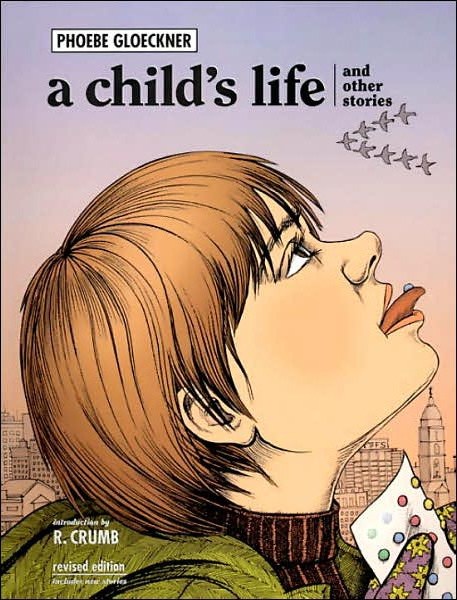
A Child's Life: Graphic Novel

A Child's Life
A Child's Life and Other Stories
Phoebe Gloeckner

This is one graphic novel that certainly lives up to its name. I'm glad I wasn't reading it in public when I turned the page and saw the panel depicting two young girls peeping in through a broken bathroom window and catching their stepfather in a *ahem* private moment. (Granted, there were far more disturbing scenes, but that was the first one that I recall being particularly explicit.)

I came across this title when I was looking for graphic novels written and illustrated by women. It seems like a lot of the well known books in this medium are by men, and if you've read my blog at all you probably know I like reading female authors. (And yes, I read male authors and yes I like them and yes Maus I & II are amazing).

The characters in A Child's Life and Other Stories are clearly based on Gloeckner's self and family and friends. It was a little odd to get used to at first, as she often changed the main character's name from story to story. It's understandable that she would want to put some distance between herself and some of these incredibly painful experiences. The stories are in rough chronological order, grouped as child years, to teen, to adult. They were not all completed at the same time, so there are very noticeable differences in drawing styles. This isn't a bad thing - in fact, the differences lend interesting visual variety.

This is not a book to willy-nilly recommend to your friends. It is intense. The subject matter is dark - excessive drug and alcohol abuse, pedophilia, rape, child abuse.

Unlike Maus, there is no attempt to depict the atrocities in anything other than minute detail. All the horrors are present for perusal, which can make you feel a bit like a creepy voyeur. What does this mean? What is the purpose of these artistic choices? Perhaps it's to force the readers' heads point at these acts, force them to watch and acknowledge they exist. Because unfortunately, there are too many children who know about them first hand.

Monday, April 30, 2012

Continuing with Aya

Aya, staged for
the mini-challenge
Aya of Yop City
By Marguerite Abouet
Illustrated by Clément Oubrerie

Aya of Yop City is the second in a series of graphic novels by Ivorian born writer Marguerite Abouet. There are six novels published in French, but only three have been released so far in English. The fourth is set to come out this summer (if anyone knows of a way to get a review copy to this blogger, she'd be eternally grateful, *hint, hint*). I read the first one, Aya, last year and loved it.

I was happy to find that my library had the second book. It picks up right where Aya left off, and it was fun to fall right back in with the delightful cast of characters populating 1970s Ivory Coast. Aya and her friends all have their own worries, but they are there to lend a hand when one of them needs something, be it babysitting or boyfriend advice.

This time around, it's not just Bintou who needs help. The girls' parents are in for some big surprises, too. Unfortunately, the book ends rather abruptly, on a big reveal that is sure to have major consequences in the third volume, Aya: The Secrets Come Out.

I read this during the April edition of Dewey's 24 Hour Readathon. I also used it as inspiration for a book-staging mini challenge hosted by Midnight Book Girl. I chose to surround the book with a bold patterned scarf, since the women in the book are find of them, stick a picture of my cute nephew in to represent the baby, and add a bright lipgloss for the town beauty contest.

Friday, January 27, 2012

Gorgeous Radioactivity

Radioactive, Lauren Redniss
Radioactive: Marie & Pierre Curie, A Tale of Love and Fallout
Lauren Redniss

I have been wanting to read this book ever since I first heard about it six or so months ago. Unfortunately, my library did not have a copy, and I kept waiting and waiting for the one they ordered to arrive. When I went the other day to pick up a hold, the librarian said, "Oh - it says you have two holds - let me go see what the other one is." To my absolute delight, it was their brand-spanking new copy of Radioactive. I gleefully snatched it up and started reading it over lunch.

Those eyes! They're staring into your soul!
Immediately, I was drawn into the book. The opening pages are in beautiful tones of blue, and green, and orange. They glow much as you imagine vials of radium glowing. Then, when you actually get into the first "real" pages, Marya Sklodowska, aka Marie Curie, stares at you through a completely captivating black and white drawing.

As much as I loved this drawing, I was a bit worried that I wasn't going to get any more of the intense color of the introductory pages. I actually flipped ahead, and was relieved to see plenty of color.

Lauren Redniss has done an amazing job tying her artwork with the story of Marie and Pierre Curie. She tells about their personal lives, their work, their interests, and the future implications of their research.

I was amazed at how much work they had to put in to their experiments. The tools they needed often didn't exist, so they made them. They were interested in anything that could enlighten them and cast light onto their experiments, even if that meant attending Spiritualist sessions where tables somehow levitated and scientists tried to measure the weight of ghostly presences.
The first x-ray of the human interior


They worked along side other accomplished scientists, including Albert Einstien, and Wilhem Röntgen, who discovered the x-ray. It was an experience to be holding the pages of the book with my left hand, next to the first x-ray, which was of the left hand of Anna-Bertha Röntgen, Wilhem's wife.


There were some jarring elements. I'd be going along, happily reading about the Curies, when suddenly I'd turn the page and be reading about the Manhattan Project or something else. The little extras were interesting, and certainly form a major part of the fallout from the Curies, but they felt out of place somehow, as if they weren't fully integrated in the rest of the book.

Another nit-picky criticism is that the text was often unevenly spaced, in places where it made no sense to space it that way. It was sometimes hard to read, because the words would be almost squished together.

Still, I rated the book overall as 4 stars. Usually I give books 4 stars because there's some little tidbit that keeps them from being 5 stars. In this instance, the book, while very good, probably was only 3 stars on its own. I bumped it up a notch because of the incredible artwork.

This copy is going back to the library, but I'm going to need a copy on my shelves to add a little beauty.

Want more like this? Try:
  • Margaret Atwood, Alias Grace. This time it's a murder mystery, but based on a real case in the mid 1800s. Some of the characters are very interested in the intersection of Spiritualism and science. 
  • Rebecca Skloot, The Immortal Life of Henrietta Lacks. Non-fiction, approachable science. 
  • Laurence Yep, Hiroshima. A slim young adult novel dealing with the aftermath of the US's atomic bombing of Japan, and the Hiroshima Maidens.

Monday, January 2, 2012

American Born Chinese: A Graphic Novel

American Born Chinese
Gene Luen Yang

In this acclaimed graphic novel, Yang tells three interconnected stories about the importance of accepting yourself.

The first tale to be introduced is that of the legendary Monkey King. Although he is an important figure in his community, he is laughed out of a party with the gods. He is determined to have his revenge.

The second story belongs to Jin, a young boy who moves from Chinatown to a predominantly Caucasian neighborhood. He is desperate to fit in and determinedly avoids his only Asian classmate. However, when Wei Chen arrives from Taiwan, Jin slowly accepts him as a  friend, until a fight tears them apart.

Finally, we meet Danny,  high school student embarrassed by his horribly stereotypically Chinese cousin Chin-kee, who visits every year. Chin-Kee's character is so over the top I was afraid my eyebrows would get stuck in the raised position.

Honestly, I was expecting more from this book. There were some interesting aspect, including the ways Yang interwove the three stories, but then the moralizing at the end was a huge turn-off. Also, I know Chin-Kee was supposed to make the reader feel uncomfortable, but I can't put my finger why he bothered he so much. It was like the book as a whole couldn't decide if it was a sophisticated commentary or an overwrought fable.

On a more positive note, I will leave you with the ever-adorable Monkey King:

Tuesday, November 29, 2011

Persepolis 2

Persepolis 2
Persepolis 2: The Story of a Return
Marjane Satrapi

Persepolis 2 starts up where the first volume left off - Marjane has left Iran for the safety of Europe, where she bounces around from house to house, school to school. I was shocked by the seeming ease with which her initial host family carted her off to a boarding school in the Alps.

Marjane has trouble fitting in and making friends. She misses her family, but tries to put on a brave face, knowing how much they've sacrificed to allow her this opportunity, and knowing what they must be going through at home with the revolution.

The pressure becomes too much when she has a bad breakup with a boyfriend. She completely breaks down and ends up homeless and suicidal. This signals the beginning of the return, when Marjane rejoins her family in Iran.

But returning to Iran does not solve her problems. Satrapi eloquently portrays her feelings of fitting in in neither a secular, Western culture, nor the Islamic, repressive society Iran has become. It is fascinating to read her story as she progresses from the headstrong young girl of volume one into the equally strong willed woman in volume two.

Satrapi's illustrations do not disappoint. On one page, she describes an art class. It's amazing how much she is able to express when the majority of the illustration is a flowing black garment.

I really enjoy graphic novels. I don't know why I haven't read more of them. Maybe I can fit in a couple more before the end of the year. Do you have any suggestions for me to look for? Let me know in the comments!

Saturday, November 19, 2011

Persepolis

Persepolis
Persepolis
Written & Illustrated by Marjane Satrapi

Yes, I know I am quite late to the Persepolis party. Oops. But I suspect not a few readers haven't gotten around to this famous graphic novel yet, so take this post a a reminder to go track it down.

Persepolis is the memoir of Marjane Satrapi's growing up in the Iranian Revolution. Her parents are Communists who supplement her school education with books like a comic edition of "Dialectic Materialism," which contains arguments between Rene Descartes and Karl Marx. Marjane is intrigued that Karl Marx resembles her God:

Marx and God facing each other. Caption reads It was funny to see how much Marx and God looked like each other, Though Marx's hair was a bit curlier.
Marjane is a willful, stubborn child growing up in a violent, confusing world. Her parents attempt to walk a fine line between keeping her safe and protected from knowledge that may hurt her and telling her information that's necessary for her to have an idea what's going on.

When it seems that they can no longer keep her safe in Iran, Marjane's parents send her to school in Europe. That's where Persepolis ends and where Persepolis II begins.

I am really happy that I finally read this. Satrapi did a wonderful job telling the story of the revolution from a child's perspective, while still writing a sophisticated, adult book. The emotions of all the characters are perfectly communicated through a combination of dialogue and illustration. If you haven't gotten your hands on this yet - Go!

(You can buy this title through  this affiliate link)

Thursday, November 3, 2011

Anya's Ghost

Anya's Ghost
Anya's Ghost
Written & Illustrated by Vera Brosgol

Anya's Ghost is a typical story of a high school girl struggling to fit in. Anya's ashamed of how her Russian immigrant heritage makes her stand out, of her thick thighs, of not having a boyfriend (or many friends at all). You might guess what makes it a bit different - the ghost of a dead girl named Emily.

Emily's been dead for over ninety years, stuck in the bottom of a well, just waiting for someone to find her. When Anya trips and falls down the same well, it seems like Emily has found her saving grace.

But Anya, being a rather selfish teenager, is mainly interested in how Emily can help her cheat on tests and get the guy she wants. Emily is happy to help, as she never really got to live a teenager's life before she died.

Things take a bit of a sinister turn when Emily decides that she really likes hanging out with Anya and living through her. I admit, I was a little creeped out at some of the illustrations. I won't post them, so if you read this you'll be surprised by them like I was.

Overall, I thought this was a fun, quick read. It has some mature themes (after all, the characters are in high school) so it's not a "comic book" for young kids.

Here's an interview with Brogol, with some additional examples of her illustration work. I was interested that she said she draws men all day at her day job, which is one reason she likes drawing women on her own time. I'm glad she had the opportunity to draw Anya and her friends, and get paid for it!

And finally, a book trailer for Anya's Ghost. No transcript necessary, as all the words are on the screen. I do recommend turning off the sound if you're viewing this at work. Not that anyone browses blogs at work, right?